
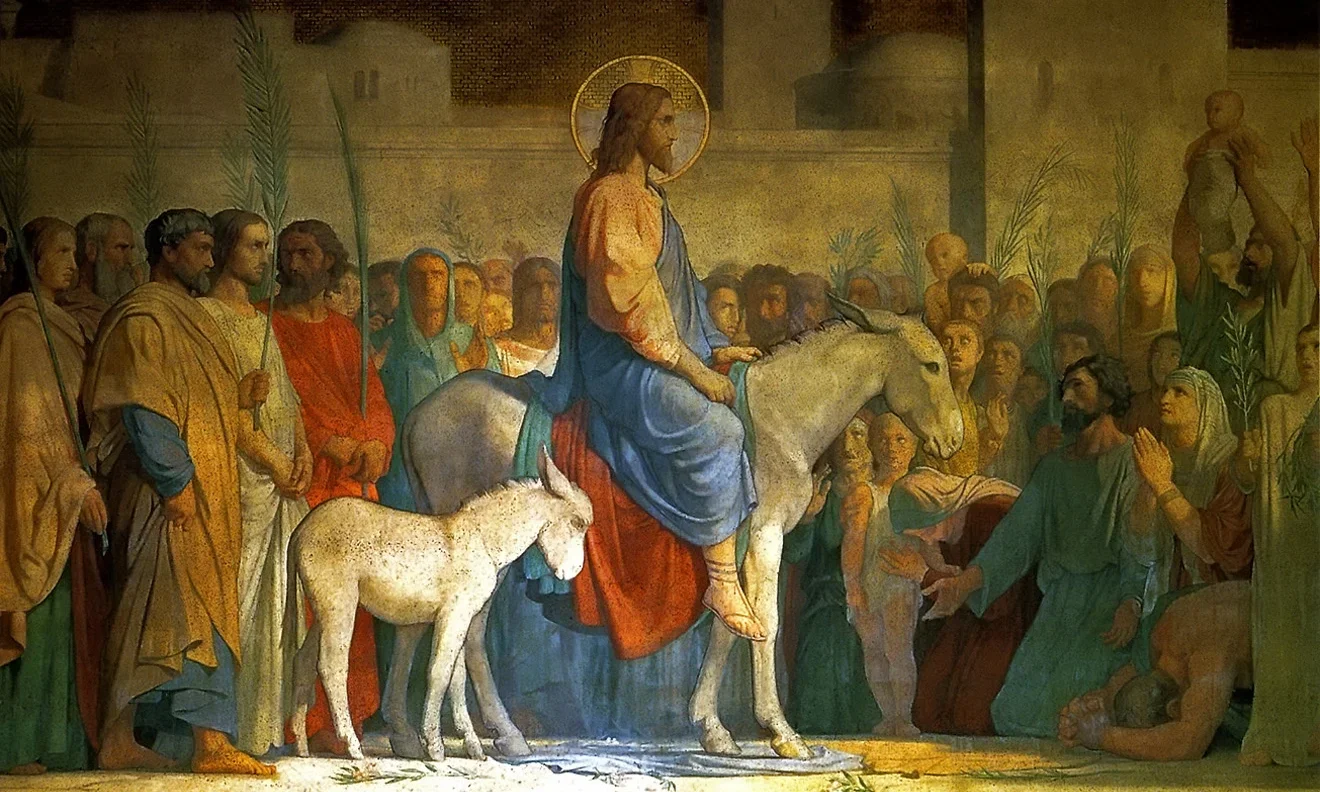
Palm Sunday opens Holy Week, commemorating both Jesus’ triumphal entry into Jerusalem and the beginning of His suffering. It is a vivid, dramatic day in the Christian calendar, even for those who rarely engage in liturgy. With palms waving, hymns rising, and the Passion narrative read aloud, we experience a striking contrast: one moment we shout “Hosanna!” in praise, and the next we cry “Crucify Him!” This juxtaposition mirrors the paradox of Christ’s kingship and the complexities of our spiritual lives, where triumph and suffering, joy and sin, coexist.
The tradition of Palm Sunday began in the early Church, which built on the Jewish custom of commemorating God’s saving acts. By the fourth century, Christians in Jerusalem reenacted Jesus’ entry, waving palms, singing hymns, and visiting holy sites. As the practice spread through Europe, blessings of palms and public processions became formalized by the eighth century. Where palms were unavailable, other plants or flowers were used, and processions were often led by a bishop, the Gospel Book, a crucifix, or an image of Jesus riding a donkey. The hymn “All Glory, Laud, and Honor,” written by St. Theodulf in the ninth century, eventually became central to the celebration.
Palm Sunday also fulfills prophecy. In the Gospels, Jesus’ entry into Jerusalem fulfills Zechariah’s prediction of a humble yet triumphant king riding a donkey. This recalls the story of Solomon, paraded into Jerusalem as the rightful heir to David’s throne. By entering the city this way, Jesus declares Himself the true Son of David—the King who saves His people and challenges worldly powers.
Christ’s kingship extends beyond the spiritual to every area of life. Pope Pius XI, in Quas Primas, emphasized that Christ’s authority covers homes, workplaces, communities, and governments. Honoring Christ as King means submitting every part of life to Him, ordering our actions and priorities according to His will. Palm Sunday reminds us that His reign is not only over our hearts, but over the whole created order.
The celebration also points us to the cross. Though the crucifixion was meant to humiliate and punish, it paradoxically serves as Christ’s throne, demonstrating true victory. St. Paul writes that Christ “disarmed” the powers of the world through His triumph on the cross (Colossians 2:15). By pairing Jesus’ triumphal entry with His Passion, the Church shows that His power is expressed not through force or politics, but through humility, sacrificial love, and obedience to God.
Palm Sunday teaches spiritual honesty. The quick shift from praise to condemnation in the liturgy reflects our own lives: we exalt Christ one moment and fall into sin the next. Christian life is not always triumphant, but it is a discipline of turning to the cross, rejecting sin, and embracing the fruits of the Spirit: love, joy, peace, patience, kindness, goodness, faithfulness, gentleness, and self-control (Galatians 5:22-23).
Ultimately, Palm Sunday calls us to welcome Christ fully—not just as Savior but as King over all. It asks us to examine our allegiances, surrender every area of life to His authority, and live in a way that declares, “Hosanna! Blessed is He who comes in the Name of the Lord!” As we reflect on His triumph and suffering, we are reminded that following Christ means ordering our hearts, homes, and communities under His kingdom. Palm Sunday is a call to recognize the King who reigns over all, and to live as faithful subjects of His eternal rule.